

Paper honeycomb is used in an enormous range of applications, from automotive load floors to fire rated doors to protective packaging. Yet a few myths about it keep circulating. Most come from the same place: judging the core on its own, when in real use it almost never works alone.
So we asked Raoul, one of our sales engineers, to set the record straight on four of the most persistent ones.
Myth 1: Paper honeycomb cannot be used outdoors
Paper and water do not sound like a good match, so I understand where this comes from. But the logic points at the wrong part. It is not the honeycomb that keeps water out, it is the skins. In any panel, the facing materials are your first line of defense. Pick skins made for outdoor conditions, and the core stays perfectly protected, whatever it is made of.
A good example is the roof of the Ford Bronco. Paper honeycomb core, exposed to the elements, performing exactly as it should. The core does not need to be waterproof. The system does.

Myth 2: Paper honeycomb is a flat, 2D material
Stacks of unexpanded honeycomb do not exactly suggest complex shapes, so I get the assumption. But with the right approach, paper honeycomb takes on three dimensional shapes. There are a few ways to do it. You can stack and bend layers in different orientations to build 3D structures without special tooling. You can add molded paper into the stack for more geometric freedom. And you can build extra forming into the die cutting or into the pressing process, along with the skins.
What makes it possible is something unique to paper honeycomb: local buckling. When pressure is applied during molding, the cells deform locally instead of failing all at once, so the panel conforms to a shape rather than collapsing. With the right mix of paper grade, cell size and core height, we can wrap panels around surprisingly tight radii. Think something as small as a football.
Myth 3: Paper honeycomb cannot be used in fire rated doors
Paper and fire seem like an obvious contradiction, so this one feels right. Yet some of the most widely used fire rated doors in North America have a paper honeycomb core, with no special fire treatment. It comes down to how fire doors actually fail. The skins carry the fire resistance, they are the barrier. Most doors do not fail because the facing burns through. They fail because the door warps. Heat on one side causes uneven expansion, the door bends, and gaps open at the edges. That is where fire and smoke get through.
Paper honeycomb prevents exactly that. Its structure spreads stress evenly across the panel, keeping the door flat even when one side faces intense heat. Paper is also a good natural insulator, so less heat reaches the other side. Steel doors rated for 30 and 60 minutes across the US and Canada rely on this every day.
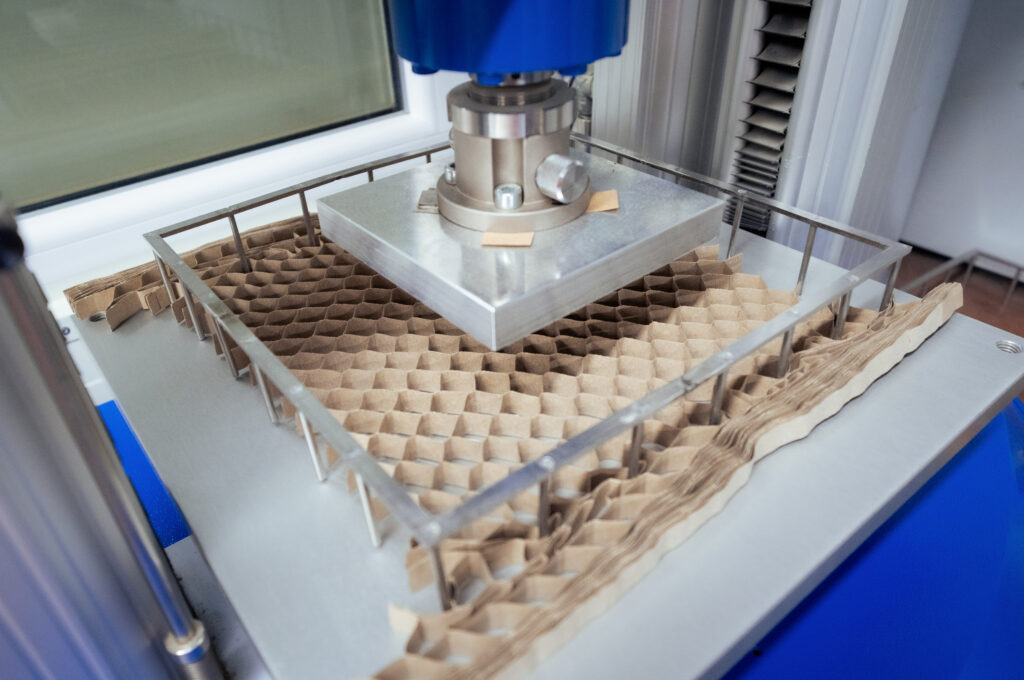
Myth 4: Paper honeycomb only handles compression
This one has a kernel of truth, which is what keeps it alive. Compression is where bare honeycomb core excels, and without skins the statement is correct. But a honeycomb panel is never just core. Add skins and you have a sandwich panel, and that is a completely different structure with a much wider load profile.
It handles shear loads, which sandwich panels spread very well, that is one of the defining traits of the construction. It handles bending and deflection, which is the main demand for things like load floors and has little to do with compression. And it handles side loads: a panel on its side eventually fails by skin buckling, but the honeycomb supports the skin along its full height. The smaller the cell size, the shorter the unsupported length, and the more load the panel takes.
So the honeycomb does not just carry load. It stabilizes the structure that does.
The pattern behind all four myths
All four myths make the same mistake. They judge the core on its own and ignore the system around it. Waterproofing, shape, fire resistance and load capacity are all properties of the panel, not the bare core.
So the better question is not “what can paper do?” but “what can this panel do?” Once you ask it that way, the answers change. The right specification is a deliberate mix of skins, paper grade, cell size and core height, matched to the application. Curious whether paper honeycomb fits yours? Our engineers are happy to think along.
Was this article helpful?